Why Makinde’s Innocent Warning to Traditional Institutions Was Given a Different Spin ||▪︎ By Isiaka Kehinde (Mr Ethics)
6th of September, 2026
By Isiaka Kehinde.
Governor Oluseyi Abiodun Makinde enjoining traditional rulers to steer clear of partisan politics, or risk being treated as politicians, is hardly controversial. What is curious, however, is the manner in which a general admonition has been selectively interpreted, distorted, and personalised.
Foremost, the governor did not mention any traditional ruler by name. His statement was sweeping and, in principle, applicable to every member of the traditional institution. Why, therefore, should anyone hastily conclude that the warning was directed at a particular monarch?
The underlying principle is quite straightforward: a traditional ruler can not simultaneously occupy the moral high horse of political neutrality and openly descend into partisan politics. Once a monarch chooses to identify with, campaign for, or openly advance the interest of a political party, it becomes difficult to sustain the argument that the institution remains above partisan contestation.
The traditional institution is a revered and sacred component of Yoruba society. Its authority derives largely from its ability to stand above the transient passions of partisan politics. Unfortunately, that authority is increasingly being weighed down by politicisation. The danger is not merely to individual monarchs; it is to the credibility and dignity of the institution itself.
Some traditional rulers may, however, be uncomfortable with a reality that former President Olusegun Obasanjo has repeatedly emphasised: in a constitutional democracy, traditional authority does not supersede the sovereignty of the state. The Yoruba proverb, “Ila kii ga ju oníré lọ”—the okra pod can not be taller than the person who harvested it—captures the principle of hierarchy in a rather unmistakable way.
When former President Obasanjo once took the reserved seat of the Ooni at the 60th birthday celebration of another traditional ruler recently and asserted that no traditional ruler occupies a position above the President, heaven did not fall. The statement was understood within the context of constitutional authority.
Likewise, when Governor Makinde made what was, in essence, an innocuous observation—that any traditional ruler who deliberately ventures into partisan politics should expect to be treated as a political actor—why should it automatically be interpreted as a coded attack on a particular monarch?
Why the haste to reach that conclusion?
It is tempting to look in the direction of one particular traditional ruler because certain recent dispositions and utterances have led sections of the public to speculate about partisan inclinations. But, speculation is not evidence, and political interpretation should not be elevated into established facts merely because it fits a preferred narrative.
As the Yoruba saying goes, “Ṣé Tẹ́tẹ̀ nìkan ni ó n Bẹ̀ lòfin?”—is Tete the only person in Ofin? If a statement is addressed to everyone, why should one person instinctively assume that it is about him?
I suspect, too, that there may be a political calculation behind the attempt to personalise the governor’s statement. Some political actors may be interested in creating the impression of a confrontation between Governor Makinde and a particular traditional ruler, thereby manufacturing a conflict that may not exist.
Such a narrative could serve the interests of those who believe that Governor Makinde and the political structure around him can not be effectively challenged at the ballot box without first creating institutional tension and political distractions. If the objective is to provoke a confrontation between the governor and traditional institutions, then the deliberate personalisation of a general statement becomes a convenient political instrument.
There is another, equally troubling, dimension to this argument: the tendency to place traditional rulers on a pedestal that is incompatible with the constitutional realities of a democratic state.
A king is a king. A politician is a politician. Neither role is diminished by remaining within its proper boundaries; both become problematic when the boundaries are deliberately blurred.
There should be no superiority contest between the political and traditional institutions. Democracy has its own hierarchy of constitutional authority, just as the traditional institution has its own cultural and historical authority. The sensible approach is not to make one institution compete with the other but to allow each to operate within its legitimate sphere.
A monarch who remains above partisan politics preserves the neutrality, dignity, and moral authority of the throne. But a monarch who voluntarily descends into the political arena should not be surprised when the public begins to scrutinise his actions through a political lens.
This is where the wisdom of Professor Ola Rotimi’s The gods Are Not to Blame becomes remarkably instructive. A man who leaves his pot unwashed can not reasonably complain when the food in it gets burnt.
The same principle applies here: a traditional ruler who deliberately enters the political kitchen cannot demand to be treated as though he never entered it.
Governor Makinde’s warning, therefore, should be read for what it plainly was—a general reminder about the delicate boundary between traditional authority and partisan politics, not an invitation to a needless confrontation with any particular monarch.
Those attempting to transform a general statement into a personal salvo may be creating a controversy that the governor himself never created.
Perhaps the most prudent counsel to all concerned is simple: let kings remain kings, let politicians remain politicians, and let both institutions preserve the dignity that comes from knowing where one belongs. .
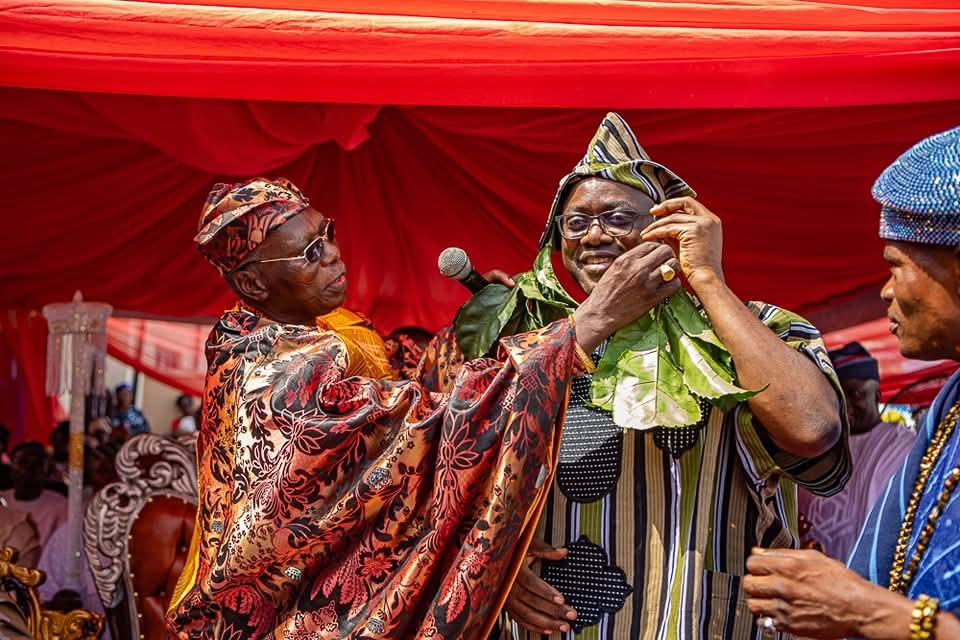
Permit me to use this piece to formally congratulate Governor Oluseyi Makinde, the latest Aare Asoludero of ibarapaland.” Oye a mori o”