Before You Lecture Makinde About Hypocrisy, Apply The Same Standard To Everyone ||▪︎ By Dr Peter Akande

Before You Lecture
By Dr Peter Akande
Sola Abegunde’s article, “Governor Makinde: Resetting Nigeria Goes Beyond Hypocrisy,” is an interesting piece, but unfortunately, beneath the loud accusations and moral posturing is a familiar pattern of Nigerian political commentary: demand accountability from the politician you dislike while conveniently lowering the same standard for those you support.
Let us be honest.
Governor Seyi Makinde is not above criticism, and nobody should be. His administration should be questioned, scrutinised and held accountable wherever there are legitimate grounds to do so. But accountability is not a political weapon that should be deployed selectively. If the writer genuinely believes in accountability, then the same microscope must be turned towards Abuja and every other government whose policies affect Nigerians.
The attempt to portray Makinde as a hypocrite simply because he criticised the manner in which the Federal Government handled fuel subsidy removal is particularly weak. Since when did criticising government policy become hypocrisy? Must a governor become President before he can express concern about an economic policy affecting his state and his people? If that is the new standard, then every Nigerian who criticises government policy should first submit a presidential manifesto.
The reality is that subsidy removal has had consequences that Nigerians can see and feel. Transportation costs increased, food prices surged, businesses faced higher operating costs and ordinary families have struggled with the rising cost of living. Therefore, asking questions about the policy is not hypocrisy. It is part of democratic accountability. Increased government revenue does not automatically mean increased welfare for the ordinary citizen. What matters is what Nigerians can actually afford and the quality of life they experience.
The author appears to suggest that because states now receive more money, criticism of the Federal Government becomes somehow illegitimate. That argument is dangerously simplistic. If government allocations increase but inflation simultaneously destroys the purchasing power of citizens, should Nigerians simply remain silent? If government revenue increases while families struggle to pay school fees, transport fares, rent and food bills, are leaders forbidden from asking questions?
No. Nigerians deserve better than that.
And if the writer wants Governor Makinde to explain how Oyo State spends its resources, that is perfectly legitimate. But Nigerians also have the right to ask the Federal Government to explain how it spends federal resources. Accountability must travel in every direction. It cannot be a one-way road leading exclusively to Agodi House while Abuja enjoys political immunity.
This is where the article begins to sound less like an objective assessment and more like political advocacy.
The author raises allegations surrounding government projects and finances. Fine. Investigate them. Publish the contracts. Publish the payment records. Publish the audit findings. Produce verifiable documents. If there is evidence of criminal wrongdoing, take it to the appropriate authorities and let the law take its course.
But an allegation is not a conviction.
An insinuation is not evidence.
A pending investigation is not a judicial pronouncement.
This distinction should matter to anyone who claims to be interested in responsible journalism.
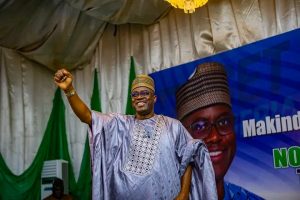
It is also curious that the article seems determined to question Makinde’s political ambition. Who exactly determines which Nigerian politician is permitted to aspire to the presidency? Governor Makinde does not need Sola Abegunde’s permission to contest an election. His political future will ultimately be decided by Nigerians through the democratic process.
If Makinde is incapable, Nigerians will reject him.
If his record is poor, Nigerians will reject him.
If his policies are unacceptable, Nigerians will reject him.
If another candidate has a better vision and stronger record, Nigerians will have the opportunity to choose that candidate.
That is democracy.
What is certainly not democracy is attempting to disqualify a politician through political commentary before voters have even spoken.
And for those suddenly presenting themselves as historians of governance, let us ask a simple question: compared with what?
If Makinde’s administration is being judged, then compare it with previous administrations in Oyo State. Compare the treatment of workers. Compare the treatment of pensioners. Compare infrastructure. Compare roads. Compare education. Compare healthcare. Compare internally generated revenue. Compare investment. Compare the overall economic and administrative direction of the state.
Let the figures speak.
Nobody is claiming that Makinde’s government is perfect. It is not. But pretending that his administration has achieved nothing simply because one disagrees with his politics is equally dishonest.
The people of Oyo State are not blind. They know what they experienced before Makinde came into office, and they know what they have experienced since then. They are capable of making their own judgment without being instructed by political commentators.
There is also a political reality that some people deliberately refuse to acknowledge: Governor Makinde has built a political identity that cannot simply be erased by partisan attacks. His political decisions, alliances and ambitions can be debated, but they cannot be wished away.
And if the argument is that Makinde cannot win nationally, that remains a prediction—not a fact. Nigerian politics has repeatedly demonstrated that today’s political calculation can become tomorrow’s surprise.
So let those who oppose Makinde organise themselves, present their candidates and convince Nigerians. Let them campaign on superior ideas. Let them present a better record. Let them tell Oyo people and Nigerians what they would do differently.
But spare us the pretence that political attacks automatically constitute accountability.
Nigeria does need a reset, but the reset must include our political culture. We need to move away from the practice of defending everything our political allies do while condemning everything their opponents do. We need to stop treating political loyalty as a substitute for evidence. We need to stop turning allegations into convictions and stop pretending that selective outrage is patriotism.
If Makinde must answer questions, Tinubu must answer questions.
If Oyo State must account for its resources, the Federal Government must account for federal resources.
If Makinde’s policies must be scrutinised, federal policies must also be scrutinised.
If Makinde’s political alliances are open to criticism, the alliances of other politicians must equally be examined.
That is what consistency looks like.
The real hypocrisy is not necessarily in questioning government policy. The real hypocrisy is demanding accountability only when it is politically convenient.
So, before anyone lectures Governor Makinde about hypocrisy, they should first apply the same standard to themselves and to the political establishment they defend.
Makinde can be criticised. He can be challenged. He can be defeated at the polls. But he should be defeated with facts, superior ideas and democratic persuasion—not through insinuations masquerading as established facts.
The 2027 political contest should therefore be about records, competence, ideas and the future of Nigeria.
And if anyone believes Makinde does not deserve the presidency, there is a very simple solution: bring forward a candidate who is better prepared, more competent and more convincing, and allow Nigerians to decide.
Until then, attacking Makinde repeatedly does not make the attacker right, just as praising him repeatedly does not make his supporters infallible.
The ballot box—not political propaganda—will have the final word.