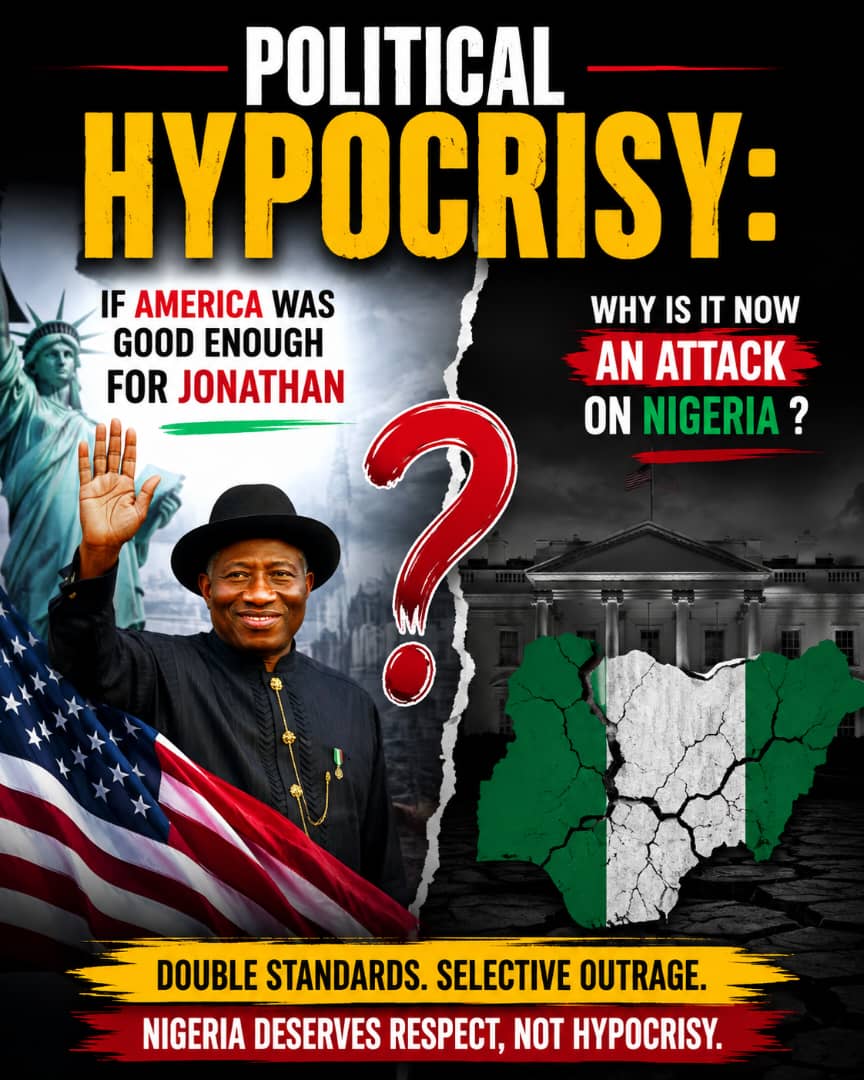
Political Hypocrisy: If America Was Good Enough For Jonathan , Why is it Now An Attack On Nigeria ? || ▪︎ By Dr Peter Akande
3rd of September, 2026.
By Dr Peter Akande
The latest intervention by former Minister of Youth and Sports Development, Solomon Dalung, has reopened an uncomfortable chapter in Nigeria’s political history—one that many political actors would probably prefer Nigerians to forget. Dalung has alleged that the opposition, including prominent figures such as Bola Ahmed Tinubu and the late Muhammadu Buhari, petitioned the United States during the administration of former President Goodluck Jonathan over insecurity and the alleged failure of the government to adequately protect Nigerians, particularly Christians. Dalung said he personally participated in the activities and is now questioning why those who sought America’s attention over Nigeria’s internal problems during Jonathan’s administration would object when similar concerns are raised about Nigeria today.
This allegation deserves serious reflection, not because Nigerians should surrender their sovereignty to any foreign government, but because it raises an important question about political consistency. When Jonathan was President, insecurity was presented by the opposition as evidence of governmental failure. Tinubu himself publicly criticised Jonathan over the security situation and demanded that the government take responsibility. The political opposition at the time did not treat international attention to Nigeria’s problems as an attack on the country. Rather, international pressure was often welcomed as part of the effort to force the government to act.
Nobody should have a problem with holding a government accountable for failing to protect its citizens. Indeed, that is one of the fundamental responsibilities of democracy. The problem begins when the standard changes simply because the political party in power has changed.
If insecurity was sufficient reason to condemn Jonathan’s government, then insecurity must remain sufficient reason to question Tinubu’s government. If the opposition had the right to demand answers from Jonathan, Nigerians today have the same right to demand answers from Tinubu. The people who were told yesterday that government must protect them cannot suddenly be told today that they have no right to complain because the person in government is now someone they once supported.
This is where the issue of political hypocrisy becomes unavoidable.
Nigeria’s political history is filled with politicians who passionately defend a principle when they are in opposition and then conveniently reinterpret that same principle when they gain power. The opposition becomes the government, and suddenly yesterday’s standards are no longer applicable. What was described as patriotism yesterday can become sabotage today. What was considered legitimate criticism yesterday can suddenly be labelled an attack on the nation.
But Nigeria belongs to all of us. A political party is not Nigeria. A president is not Nigeria. A political leader is not Nigeria. The country is bigger than every individual politician and every political party.
There is also an important distinction that must not be ignored. Nigeria is a sovereign country, and Nigerians should not support any attempt by a foreign government to dictate the country’s political destiny. America should not govern Nigeria, just as Nigeria should not attempt to govern America. However, national sovereignty should never become a convenient shield against accountability. A government that is confident in its ability to protect its citizens should be able to respond to criticism with facts, results and transparent action rather than simply dismissing every criticism as foreign interference.
The strongest response to international concern about insecurity should not merely be anger or accusations of interference. It should be evidence that Nigerian citizens are being protected, that criminals are being brought to justice and that communities are becoming safer.
This is why Dalung’s argument deserves attention. If it is established that political actors who are now uncomfortable with international scrutiny once sought that same scrutiny against a previous administration, Nigerians are entitled to ask why the standard has changed.
The question is not whether America should control Nigeria. The question is whether Nigerian politicians should be judged by the same standards they demanded from their predecessors.
If Jonathan was expected to answer questions about insecurity, Tinubu must also answer questions about insecurity. If Jonathan was expected to explain economic hardship, Tinubu must also explain economic hardship. If Jonathan was expected to account for the protection of Nigerian lives, the same expectation must apply to every administration that follows him.
The person occupying Aso Rock may change, but the constitutional responsibility of government does not change.
Dalung’s comments are also significant because he is not speaking as someone who merely watched the events from a distance. He has acknowledged his participation in the political activities that helped bring the APC to power and has expressed regret about his involvement. Whether one agrees with his present political position or not, his statement provides an opportunity for Nigerians to reflect on the consequences of political loyalty.
Many Nigerians joined political movements because they genuinely believed those movements would transform the country. They believed promises of change, better security, economic prosperity and improved governance. But political parties should never be treated like football clubs where supporters defend everything simply because it comes from their side.
We must learn to separate party loyalty from national interest.
When Jonathan was in power, Nigerians had the right to criticise him. When Buhari was in power, Nigerians had the right to criticise him. Now that Tinubu is President, Nigerians have exactly the same right to scrutinise his administration. That is not hatred. That is democracy.
The same applies to international criticism. If international attention was welcomed when it was directed at an opposing government, it cannot automatically become an attack on Nigeria simply because it is now directed at the government one supports.
This selective application of principles is one of the reasons public confidence in Nigerian politics remains weak. Politicians frequently remember what they said yesterday only when it benefits them today. Statements made in opposition are conveniently forgotten after assuming office, while old criticisms of political opponents are recycled whenever convenient.
Nigeria deserves better.
Our political discourse should move beyond the question of “whose party is in power?” The more important question should be: “Is the government doing what is right for Nigerians?”
If the government is doing well, praise it. If it is failing, criticise it. If it makes a good policy, support it. If it makes a harmful policy, oppose it. If lives are being protected, acknowledge it. If citizens are suffering, demand action. This should be the standard regardless of whether the president belongs to APC, PDP or any other political party.
The lesson from Dalung’s intervention is therefore bigger than Tinubu, Jonathan or America. It is about the kind of political culture Nigerians want to build.
We cannot continue to celebrate politicians for condemning the same things in opposition that they defend in government. We cannot continue to change our definition of patriotism according to who occupies the presidency. We cannot continue to condemn international pressure when it affects our preferred politician while celebrating it when it is directed at our opponent.
If a principle was right yesterday, it should remain right today.
If seeking international attention over insecurity was wrong under Jonathan, then it was wrong when it was done against him. But if it was considered legitimate then, those who supported it must be prepared to accept that Nigerians and the international community may raise similar concerns today.
The standard must be one.
Nigeria does not need politicians who remember principles only when they are in opposition. Nigeria needs leaders who can stand by the same principles whether they are holding power or challenging those who hold it.
Ultimately, the greatest danger to our democracy is not criticism from America or any other foreign country. It is our own willingness as citizens to excuse political hypocrisy whenever it benefits our preferred political camp.
Nigeria will become stronger when we stop asking, “Who is doing it?” and begin asking, “Is it right?”
That is the standard by which Jonathan should have been judged. It is the standard by which Buhari should have been judged. And it is the same standard by which Tinubu must be judged.
The Nigerian people deserve nothing less.