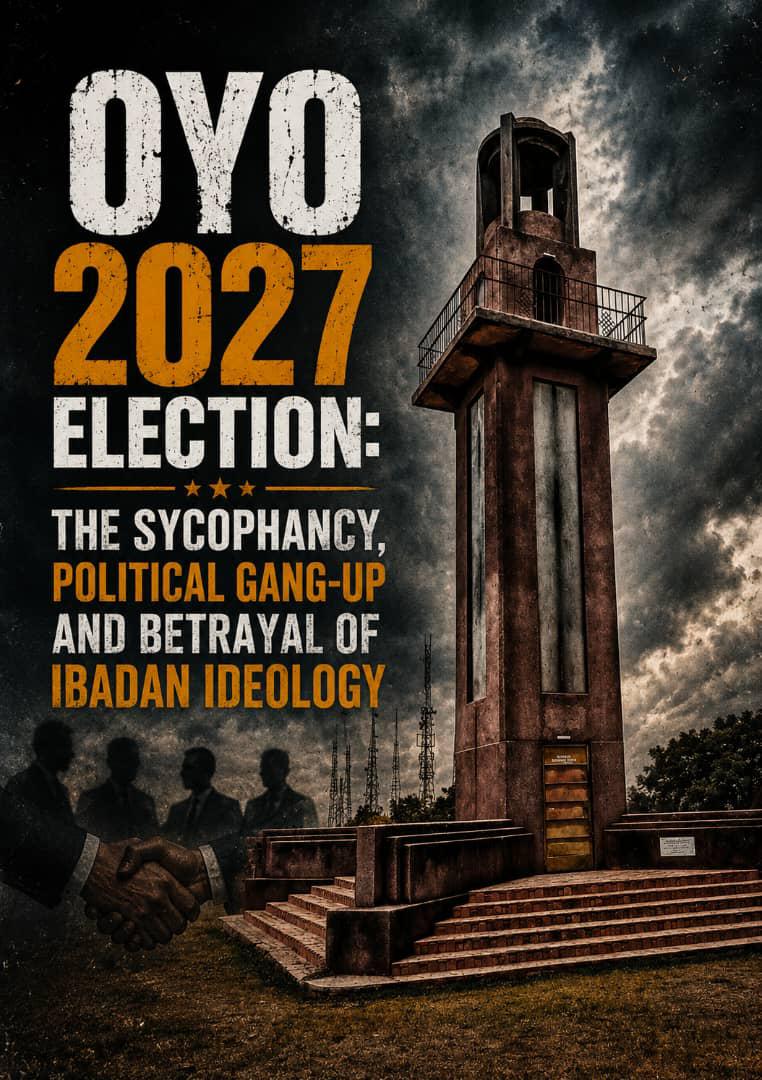
Oyo 2027 Election: The Sycophancy, Political Gang-up And Betrayal Of Ibadan Ideology || ▪︎ By Dr. Peter Akande
By Dr. Peter Akande
1st of September 2026.
I have carefully observed the increasing criticisms directed at the administration of Governor Seyi Makinde and, as an indigene and scholar of Ibadan, I believe it is time to respond to some of the narratives being circulated. My concern is not to hold brief for Governor Seyi Makinde, nor to suggest that his administration is perfect. Rather, my concern is about the larger interest of Ibadanland, the dignity of our traditional institutions, the unity of our people and the political future of Oyo State.
Before the end of this write-up, I believe discerning readers will begin to ask whether some of the criticisms being presented as matters of principle are genuinely motivated by the interests of Ibadanland or whether political calculations, personal ambitions, sycophancy and the struggle for relevance ahead of the 2027 general elections are gradually overshadowing the collective interest of our people.
There is absolutely nothing wrong with criticising government. Constructive criticism is an essential component of democracy. However, when criticism becomes selective, politically motivated and targeted at one individual while similar actions by others are ignored, it becomes necessary to question the motive behind such criticism.
In the olden days, the roles of our traditional institutions were clearly understood. Traditional rulers and elders were expected to protect the history, dignity, unity and collective interests of the people. Our elders have a saying: “Àgbà kì í wà l’ọjà kí orí ọmọ tuntun wọ.” The saying reminds us that where elders are present, younger people should not be allowed to behave recklessly or destroy the values of the community.
Unfortunately, one cannot help but wonder whether some aspects of the 21st-century traditional institution in Ibadan are gradually being dragged into partisan politics. Traditional institutions should not become instruments for settling political scores. They should remain institutions above party politics, personal interests and electoral calculations.
An institution that is respected by all political parties loses part of its moral authority when it appears to take sides in political battles. This is why it is troubling when respected Ibadan elders, who should ordinarily serve as bridges among our people, are perceived to be taking positions that deepen political divisions among Ibadan sons and daughters.
There is another Yoruba expression that says, “Ohun tí kò dára, kò l’orúkọ méjì.” What is wrong does not become right simply because it is committed by someone we respect or support politically.
I was raised with values that taught me that dignity must never be exchanged for temporary benefits. I remember my father telling me when I was young that it is better to sleep hungry than to eat as a visitor in another person’s house. That lesson has remained with me because it speaks directly to the question of dignity, independence and loyalty to one’s roots.
This is why I become concerned whenever I see people who have consistently written about the beauty, history and uniqueness of Ibadan chieftaincy matters becoming silent when the same institution is perceived to be influenced by contemporary political interests.
We must ask ourselves: Where is the spirit of the founding fathers of Ibadan?
Ibadan was built by men and women who understood courage, resilience, independence and communal interest. It was not built merely for political convenience.
The history of Yorubaland itself contains painful lessons about what greed, selfishness, division and betrayal can produce. The historical experience surrounding Ilorin and the political struggles that affected the Yoruba people should remind us that when personal interests are placed above collective interests, the consequences can last for generations.
We must therefore be careful not to reproduce old mistakes in a modern political environment.
Ibadan is the land of Ogunmola, a city renowned for courage, enterprise, resilience and political sophistication. But today, one sometimes wonders whether the political sophistication of Ibadan is being transformed into a theatre of political comedy.
The events surrounding the 2003 general election remain instructive. I remember how Governor Lamidi Adesina faced political opposition from certain Ibadan interests, including respected elders who were expected to understand the importance of supporting one of their own.
Chief Rashidi Ladoja eventually emerged as Governor, and Ibadan celebrated.
But the celebration was followed by events that demonstrated how quickly political alliances can change when interests collide.
Our people have a saying: “Pàṣán tí a fi nà ìyàwó àgbà ni a fi ńnà ìyàwó kékeré.” The lesson is that political actions taken against one person today can eventually be used against another person tomorrow.
The political confrontation between Governor Ladoja and Chief Lamidi Adedibu became one of the most significant political struggles in modern Oyo State history. The disagreements surrounding political influence and the sharing of state resources divided the political class and, by extension, Ibadan society.
Some people supported one side; others supported the other.
Ibadan was divided.
Eventually, Governor Ladoja was impeached.
The involvement of the federal government under President Olusegun Obasanjo added another dimension to the crisis. The political atmosphere of that period was also influenced by the disagreement between Governor Ladoja and President Obasanjo over the controversial third-term project.
History has a way of returning to challenge us.
Today, when political actors who once opposed the extension of political tenure appear to support or contemplate similar arrangements, one is naturally compelled to ask: What has changed?
Is political principle permanent, or does it change according to who benefits?
These are legitimate questions that the people of Oyo State deserve to ask.
During the administration of Governor Abiola Ajimobi, another political confrontation emerged between the government and some traditional institutions. Many people interpreted that confrontation as part of the continuing political struggle involving Chief Ladoja and other political actors.
Those of us who believed that Ibadan’s traditional institutions should be protected from partisan political battles opposed what we considered an unhealthy development.
We believed then, as we should believe now, that traditional institutions must be protected irrespective of the political party in power.
When Governor Seyi Makinde became Governor of Oyo State, many Ibadan people hoped that the era of destructive political confrontation between government and traditional institutions had finally come to an end.
We hoped for peace.
We hoped for unity.
We hoped that Ibadan would stop fighting itself.
But one must now ask: Are we destined to repeat the same mistakes?
Governor Seyi Makinde is an Ibadan son. Chief Rashidi Ladoja is an Ibadan son. Senator Sharafadeen Alli is an Ibadan son. Hon. Adekanbi is an Ibadan son. Oloye Adegoke is an Ibadan son. The political class may belong to different parties, but their shared identity as Ibadan people should never be forgotten.
Political disagreement is normal. Political competition is legitimate. But political warfare among people who share the same ancestral heritage is dangerous.
Why should an Ibadan man always become the political instrument for destroying another Ibadan man?
Why should our elders be mobilised to support one Ibadan son against another simply because of political affiliation?
Why should traditional institutions be dragged into partisan battles?
And why should people who claim to defend Ibadan’s interests become silent when political actors use Ibadan’s traditional structures to advance personal political ambitions?
As we approach the 2027 general election, these questions will become even more important.
There will be political realignments. There will be alliances. There will be defections. There will be endorsements. There will be political dinners and meetings. There will be attempts to mobilise traditional, religious, community and professional institutions.
All these are normal features of democratic politics.
But Ibadan must not lose its soul in the process.
The political ambition of any individual should not be more important than the collective interest of Ibadanland.
If a politician is wrong, criticise him.
If Governor Makinde makes a mistake, criticise him.
If Chief Ladoja makes a mistake, criticise him.
If Senator Alli makes a mistake, criticise him.
If Hon. Adekanbi makes a mistake, criticise him.
If Oloye Adegoke makes a mistake, criticise him.
But let the standard be the same.
Do not condemn one Ibadan man for doing what you excuse another Ibadan man for doing simply because they belong to different political camps.
That is not principle.
That is political expediency.
And while criticising Governor Makinde, we must also be fair enough to acknowledge what his administration has achieved.
Governor Makinde cannot do everything. No governor can.
But where a government performs well, it deserves commendation.
In the area of workers’ welfare, the Makinde administration has demonstrated a level of commitment that deserves recognition. Indeed, when one compares the current situation of workers in Oyo State with what obtains in many other states, there is a basis to acknowledge that Oyo workers have enjoyed relatively better attention under the present administration.
This is particularly important because workers are the engine of government. A government that pays attention to workers’ welfare, salaries, pensions, allowances and working conditions deserves to be recognised for it.
We should also remember the pensioners who suffered neglect and hardship in the past. Many of those who were once forgotten are today able to rejoice because their welfare has received greater attention. We should not erase their experiences simply because we are politically opposed to the governor.
The same fairness should apply to education.
The upgrading and transformation of some colleges of education into university-level institutions is a significant development in the educational landscape of Oyo State. Whatever political disagreement anyone may have with Governor Makinde, the expansion of access to higher education and the strengthening of tertiary institutions should be acknowledged as a positive development.
Infrastructure is another area that deserves attention. Across Oyo State, road construction and rehabilitation have become visible components of the present administration’s development agenda. Some roads may still require attention, and there are certainly communities that will continue to demand more infrastructure. That is normal. Development is a continuous process.
But acknowledging what has been done does not amount to becoming a political supporter.
There are also other sectors where the administration has made efforts that deserve objective assessment. Governance should not be judged only by what has not been done. It should also be judged by what has been achieved.
I am particularly concerned about the welfare and opportunities available to young graduates serving the nation through the National Youth Service Corps. Compared with what obtains in many other parts of Nigeria, corps members serving in Oyo State have had reasons to appreciate the environment created for them. Where a government creates a relatively better environment for young Nigerians undertaking national service, that too should be recognised.
This is the essence of fairness.
You cannot say that a governor must be praised only when he belongs to your political party.
You cannot say that everything done by an administration is bad simply because you are interested in another political arrangement.
And you cannot say that acknowledging good governance makes someone a sycophant.
There is a difference between sycophancy and fairness.
Sycophancy is praising someone because you want something from him.
Fairness is giving credit where credit is due.
Governor Makinde cannot solve every problem in Oyo State. No human being can. There are still roads to construct, schools to improve, hospitals to strengthen, employment opportunities to expand and communities to develop.
But because he cannot do everything does not mean he has done nothing.
Let us therefore praise him for what he has done well and criticise him constructively for what remains to be done.
That is democracy.
That is responsible citizenship.
That is how we build a better Oyo State.
My position is simple: I am not holding brief for Governor Seyi Makinde; I am holding brief for Ibadan and Oyo State.
I am not asking anyone to support Governor Makinde simply because he is an Ibadan man. I am asking us to apply the same standard of justice to every Ibadan son and daughter.
If Governor Makinde deserves criticism, criticise him.
If he deserves commendation, commend him.
But do not manufacture political hostility simply because another politician wants to return to power.
Do not weaponise traditional institutions.
Do not manipulate our elders.
Do not turn Ibadan’s historical institutions into instruments of political warfare.
The 2027 election will come and go.
Politicians will win and lose.
Governors will leave office.
Senators will complete their terms.
Political parties will change.
But Ibadan will remain.
Our children will inherit whatever legacy we leave behind.
They will remember whether we protected the dignity of Ibadan or sacrificed it on the altar of political ambition.
This is why I respectfully appeal to our elders, traditional rulers, political leaders, intellectuals and community leaders: please remain above partisan politics.
You are not supposed to be the foot soldiers of politicians.
You are supposed to be the custodians of wisdom.
You are supposed to be the people who call politicians to order when they become excessive.
You are supposed to be the bridge between opposing political camps.
An elder should be able to sit with Governor Makinde today and Chief Ladoja tomorrow.
An elder should be able to advise Senator Alli without becoming his political supporter.
An elder should be able to criticise the government without becoming an opposition politician.
That is the dignity of eldership.
As we move towards 2027, I therefore appeal to Senator Sharafadeen Alli, Governor Seyi Makinde, Hon. Adekanbi, Oloye Adegoke and every other Ibadan political leader: let us be guided by the larger interest of Ibadan and Oyo State.
Be political, but do not become destructive.
Compete, but do not destroy.
Disagree, but do not divide Ibadan.
Support your candidate, but do not turn our traditional institutions into political battlefields.
The greatest danger facing Ibadan is not that one politician will defeat another. The greatest danger is that Ibadan people will allow political ambition to destroy the unity, dignity and institutions that our forefathers struggled to build.
The 2027 election should therefore not become another chapter in the long history of Ibadan people destroying one another for the benefit of politicians whose interests may not survive the election cycle.
Our founding fathers left us a city built on courage, enterprise, independence and communal pride.
Let us not betray that heritage for political relevance, contracts, appointments, money or temporary access to power.
If we truly love Ibadan, then we must learn to put Ibadan above individual political ambition.
Governor Makinde cannot do everything. But where he has done well, let us praise him. Where he has failed, let us criticise him. Where improvement is required, let us demand it.
That is not sycophancy.
That is fairness.
Political positions are temporary.
Political parties are temporary.
Appointments are temporary.
But Ibadan is permanent.
Let us therefore protect what belongs to all of us.
Ibadan first.
Oyo State first.
The people first.
— Dr. Peter Akande