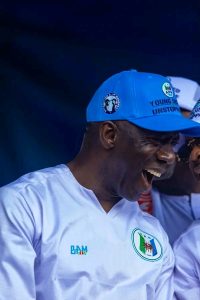
Bimbo Adekanmbi: The Pure Gold from a Dirty Alcove

8Bimbo Adekambi’s humble beginning can be likened, in some respects, to the early life of Abraham Lincoln—a story shaped by humble origins, hard work, self-education and an extraordinary determination to rise above circumstances. Born into modest surroundings and raised with strong family values, Adekambi fashioned himself through discipline, learning and perseverance, eventually acquiring the capacity to make his mark not only in Nigeria but beyond its shores.
In the days of yore, before anyone aspired to occupy a great position, one question was almost inevitable: “Omo ta ni?”—whose child is he? What is his family background? The underlying assumption was that greatness had to be inherited: that one must be born great to achieve greatness.
But capacity has changed that narrative.
The son of a woman popularly remembered as Omo iya Elelubo, whose mother sold cassava flour to raise her family, can today aspire to become the governor of Oyo State.
This is a powerful reminder that greatness is not necessarily a birthright; sometimes, it is the product of character, capacity, courage and perseverance.
Brain, not brawn, does it….
Adekambi presents a combination of street wisdom, native intelligence and formal education, reinforced by personal virtues that matter in public leadership: humility, integrity, accountability, respect, transparency, courage and financial prudence.
Recently, when he took his campaign to its grassroots at Bodija Market to solicit the support of market men and women, while also sharing souvenirs with them, the reception was revealing. The traders did more than welcome him; they effectively answered the old “Omo ta ni?” question by proudly identifying him as “our own son.”
There is indeed wisdom in the Yoruba admonition:
“Bí o bá gun òkè, má gbàgbé ibi tí o ti bẹ̀rẹ̀.”
No matter how high you climb, never forget where you started.
That proverb resonates deeply with Adekambi’s story.
The high point of the visit was almost like a testimonial advertisement—not scripted, not orchestrated, but spontaneously supplied by someone who knew the story from its beginning. A woman among the market traders recalled in Yoruba:
“Tí wọ́n bá ti school dé, ibi yìí ni wọ́n máa ń dà sí.
In essence: Whenever he returned from school, this place was always his port of call.
That simple recollection carries a profound message. It is the kind of testimony that money cannot manufacture and political propaganda cannot easily replicate. It speaks of a traceable past—a past known by ordinary people who encountered him before political ambition entered the picture.
I draw at least three lessons from that episode.
First, a traceable past matters. A person’s history can speak volumes about his character long before he acquires a title or political office. There is something reassuring about a leader whose journey can be traced from the ordinary streets of his beginnings to the heights of his present aspirations.
Second, humble beginnings can shape a different understanding of leadership. I recall the late Chief Lamidi Adesina Adedibu making a similar observation: that if he had to choose between two people in a political contest, he would rather support the person who understood humble beginnings than someone born with a silver spoon but without the qualities required for leadership. Whether one agrees entirely with that philosophy or not, its underlying lesson remains compelling: experience of ordinary life can influence one’s understanding of ordinary people.
Third, humble beginnings can be the prelude to extraordinary heights. The soil from which a person emerges does not necessarily determine the height to which he can rise. Sometimes, the roughest beginnings produce the most remarkable journeys.
As the saying goes:
“Be grateful for humble beginnings, because the next level will always require so much more of you.”
And here lies the intriguing irony in Adekambi’s political journey.
Here is a man whose story is associated with elubo—cassava flour, a product of humble beginnings, who has now emerged to contest the governorship of Oyo State under the banner of (APM), a party whose logo itself features cassava.
What an intriguing coincidence of fate!
From elubo to the governorship contest; from the market stall to the political stage; from asking “Omo ta ni?” to becoming “ọmọ wa”—our own son.
So, permit me to sing along with the new refrain from an APM admirer:
“Ẹgbẹ́ elégbé má ní ó gbàjọba,2ce
Àti ìjọba òkè, ìjọba àárín,
Àti ìjọba ìsàlẹ̀,
Ẹgbẹ́ elégbé náà ni ó APM all the way !