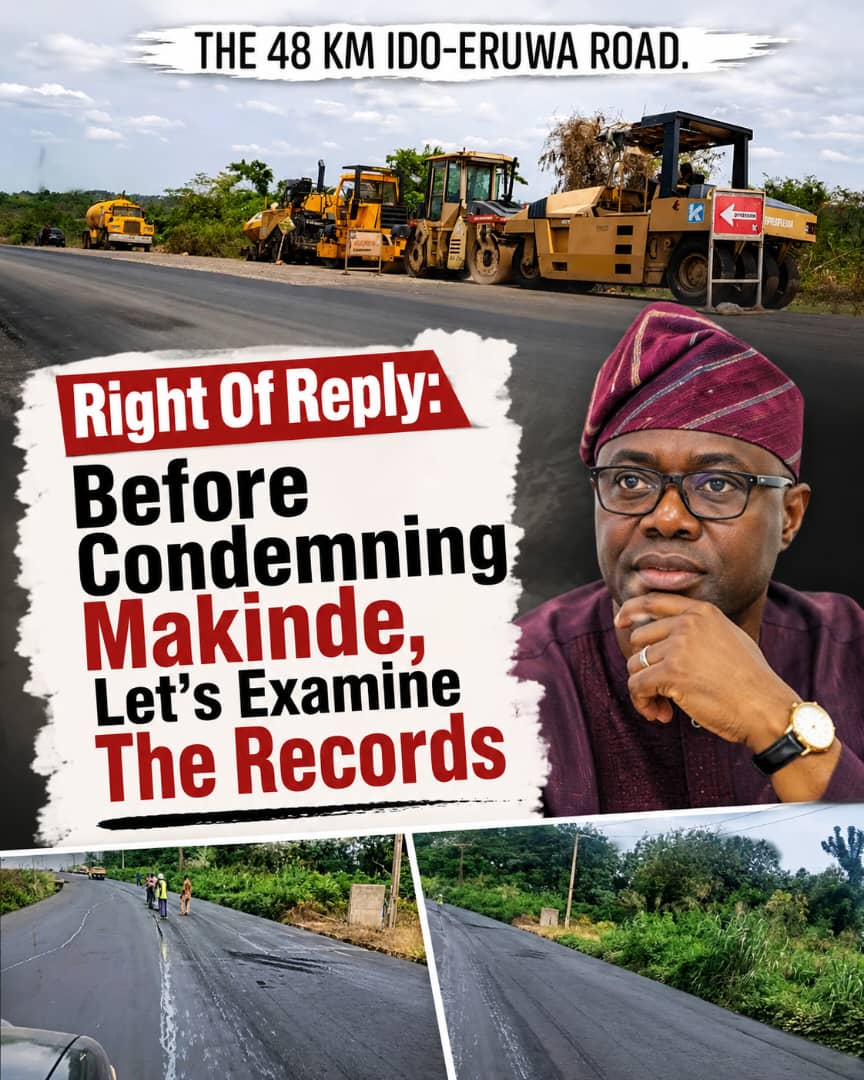
Right Of Reply: Before Condemning Makinde, Let’s Examine The Records || ▪︎ By Dr Peter Akande
By Dr Peter Akande
The attempt by Team Arapaja to use the condition of the Ido–Eruwa Road as the sole yardstick for judging Governor Seyi Makinde and questioning the conferment of the Aare Soludero title is nothing more than selective political criticism.
Let us be clear: the people of Ibarapa deserve good roads, and nobody should discourage them from demanding the completion of important road projects. But if we are going to discuss governance, then let us discuss it honestly and comprehensively—not selectively.
Team Arapaja should also explain the political circumstances behind its present alignment. Was it not after your preferred political master was reportedly not considered the party’s candidate that he became increasingly opposed to Governor Makinde and began identifying with Senator Sarafa Alli? If political disappointment is responsible for the present realignment, then the public deserves to know.
Politics is legitimate, but personal political interest should not be disguised as a sudden discovery of concern for good governance.
There is another important point that Team Arapaja should address. When internal disagreements and political realignments took place within the PDP, particularly around the factional struggles involving Nyesom Wike and the political relationships that emerged around President Bola Tinubu, Governor Makinde chose his political path rather than remaining where he believed his political interests and principles could no longer be accommodated.
If Governor Makinde could make a political decision when circumstances demanded it, perhaps Team Arapaja should also have the courage of its convictions. If you genuinely believe that the present political platform no longer represents your ideals or interests, why not take your own independent political path instead of remaining inside the same house while constantly attacking its occupant?
That is a question worth answering.
Nobody should be forced to remain in a political party against his conscience. But politics should also have principles. One cannot continually accuse another person of betrayal while celebrating one’s own political realignments as strategic wisdom.
And this brings us to the question of competence.
When you were Deputy Governor, what happened to the development of your area? What were the major achievements that the people can point to today and say, “This is the legacy of that administration?” It is easy to criticise a sitting government, but leadership should also be judged by what one did when one occupied a position of authority.
The same standard must apply to Senator Sarafa Alli, whom this political camp is promoting. As a former Senator representing the people in the National Assembly, what concrete legislative achievements can he place before the people? What bills or major legislative interventions can the people identify with his representation?
Did his constituents sufficiently enjoy the dividends of democracy during his tenure?
And before becoming a Senator, when he served as a Local Government Chairman, what enduring achievements did he leave behind?
These are legitimate questions. Competence must be the key consideration, not political friendship, personal loyalty or temporary alliances.
There is also an interesting irony in the current political arrangement. Some of those now singing Hosannah for Sarafa Alli are the same people who, during the administration of Governor Rashidi Ladoja, were loudly saying “Crucify him!” when he served as Secretary to the State Government.
What has changed?
Has the record changed, or have political interests changed?
Political alliances can produce strange bedfellows. People who once disagreed vehemently can suddenly become political allies when their interests converge. It is a reminder of the Biblical account of people who had different interests but found common ground when they wanted to achieve a particular objective.
But there is a warning here for everyone involved in politics: do not become so consumed by political ambition that yesterday’s enemy becomes today’s saint simply because political interests have changed.
And if Team Arapaja wants to invoke Biblical comparisons, perhaps it should also reflect on the danger of becoming the political equivalent of Judas—someone perceived by supporters as turning against the very political family with which he once stood because circumstances and interests changed.
Governor Makinde himself has demonstrated that when political circumstances become fundamentally incompatible with one’s direction, a politician can choose another path. Team Arapaja should therefore decide what it truly believes and have the courage to stand by it.
The people are watching.
Governor Seyi Makinde should certainly be held accountable for every uncompleted project. The Ido–Eruwa Road should be completed. The people of Ibarapa should continue to demand quality infrastructure, and the government must respond to those demands.
But accountability must be a two-way street.
If Team Arapaja wants to assess Governor Makinde’s performance, let them put his complete record side by side with the records of those they are promoting. Let the people compare achievements in infrastructure, education, healthcare, workers’ welfare, pensioners’ welfare, agriculture, security, roads and economic development.
Let us stop pretending that politics is about one road or one traditional title.
Aare Soludero is an honour; it is not a declaration that every problem in Oyo State has disappeared. Governor Makinde can receive recognition for his contributions while citizens continue to demand the completion of outstanding projects. There is no contradiction in that.
The people of Ibarapa are sophisticated enough to understand the difference between constructive criticism and political opportunism.
If the road is bad, let us demand that it be fixed.
If a project is delayed, let us demand accountability.
But if we are going to talk about governance, let everybody bring his record to the table.
Those who had the opportunity to serve should tell the people what they achieved. Those who served in the National Assembly should explain their legislative contributions. Those who chaired local governments should present their legacies.
Those seeking another opportunity to govern should explain precisely what they will do differently.
And above all, competence should be the standard.
The people should not be deceived by political realignment motivated by personal grievances or disappointment over political positions. Political parties and candidates should be judged by what they can offer the people, not merely by who is angry with whom.
At the end of the day, it is not political noise, titles, alliances or propaganda that will decide the future of Oyo State.
It is the record—and ultimately, the people.