Bimbo Adekanmbi : The Distinction Between Realism And Idealism | | ● By Isiaka Kehinde (Mr Ethics)
Isiaka Kehinde.
You can not touch what you can not hold, and you can not make an impossibility possible except in the Alice-in-Wonderland world of fantasy. These two truisms seem to elude some opposition parties who, in the imagery of our elders, are merely “f’enu ya eran s’obe”—using the mouth to put meat into the soup; chasing shadows and mistaking wishful thinking for political reality.
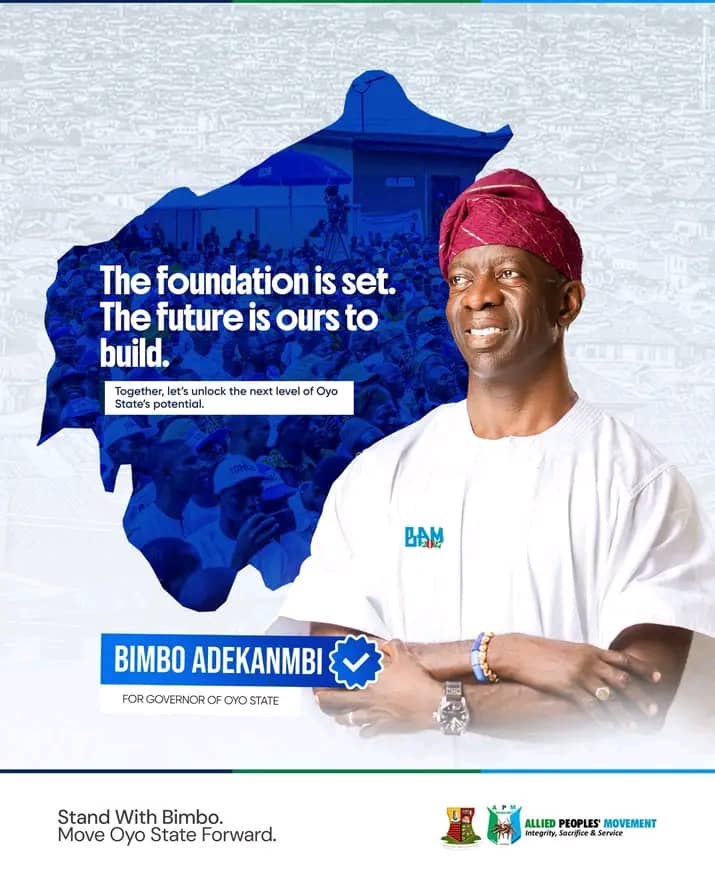
Bimbo Adekambi, the APM governorship candidate, makes a clear-cut distinction. He knows his limitations, understands the terrai, and pursues what is achievable rather than what is illusory. This reminds me of the philosophical tension between realism and idealism.
William Arthur Ward once observed: “The pessimist complains about the wind; the optimist expects it to change; the realist adjusts the sails.”
There is, indeed, a wall of demarcation between what is and what ought to be. Idealism gives us the destination; realism understands the terrain and works out the practical route to get there.
The realist does not surrender to the imperfections, and neither does it bask to the euphoria of the predecessors’ achievements. Rather, he confronts them, mends the cracks and changes the system where it falls short—without waiting for applause. He understands that good governance is not a collection of grand promises but a continuous process of identifying problems, deploying resources intelligently, and delivering measurable results.
I read, barely a week ago, about attempts by opposition parties to whip up sentiments over the purported decampment of APM members to their fold in areas where APM has already established a strong presence and where its structures are actively mobilising voters ahead of 2027. Social media was then deployed to blow the trumpet, apparently in the hope of creating an impression larger than the reality on the ground.
But, as i always say,politics is not won by social media trumpeting .
One can not manufacture political strength by repeatedly announcing what’s larger than life. Nor can a party build credibility by promising, in one year, what it could not accomplish in two consecutive terms in office. That, too, belongs to the realm of political fantasy.
The difference with Bimbo Adekambi is his emphasis on structure, organisation, and measurable action. His grassroots structure provides an avenue for sustained voter mobilisation, while his political engagement is built around understanding communities rather than merely announcing their existence.
Even his thoroughly professional media team reflects this philosophy. They only report events as they happen on the ground, without gilding the lily or manufacturing political miracles. There is a profound difference between reporting political reality and creating political fiction thas has become a stock in trade of the opposition parties.
As 2027 approaches, Adekambi’s approach is increasingly defined by a roadmap: understanding the present challenges, identifying the gaps, determining what can realistically be achieved, and setting out how those challenges can be addressed. It is a vision grounded in the realities of governance rather than a catalogue of promises designed merely to excite the electorates.
That is where idealism meets realism.
The idealist may describe Oyo State—we all desire. The realist asks the harder question: How do we get there from where we are today?
Adekambi’s political proposition, as presented by his campaign, belongs to the latter conversation. It is about moving from aspiration to implementation, from rhetoric to structure, and from promises to a practical roadmap hallmark by continuity.
That is the difference between talking about what ought to be and organising to make it possible.
And that, ultimately, is the difference between an idea and an action taker.